
I finished my last blog at the point where – as a farmer working with my brother John, the farm bought an Apple II.
Our Apple II had 64k memory – the limit for 8 bit processors (my current PC has a billion times as much memory), but that was enough, at last, for a person working at home to create a commercial program.
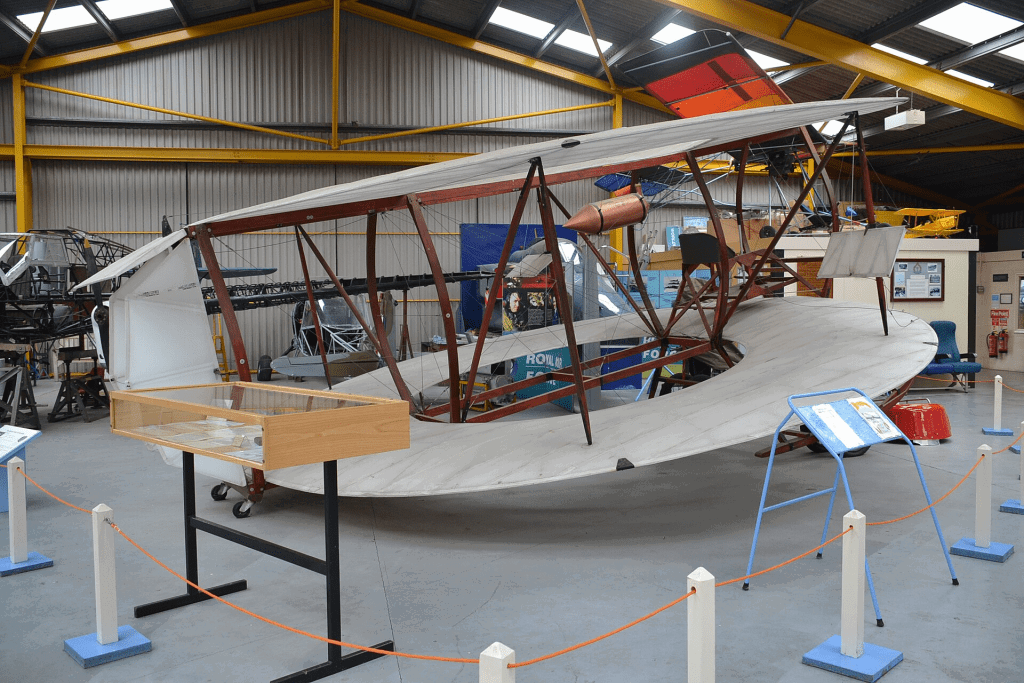
My family has a photo, taken before the first world war, of my great uncle Cedric, dressed in tweeds, taking to other early aviation pioneers in front of the round-winged aeroplane that he and his partner had invented. At a period when there were more horses than cars on the road, he was experimenting with flying, without a parachute in a gadget made of wood, canvas and string and powered by a motor that was less powerful and less reliable than most mower engines nowadays.
Playing with a PC happily offered none of the dangers, but I did feel the same sense of opportunity that Cedric must have felt.
In my case this started with trying to write a usable accounts program for our farm, and ended with writing an operating system and programming language for a software house with 4000 customers. In one of these accidents of life, I found that there was a software business locally – Farmplan – that already had a customer base, so I thought I’d show Paul Scudamore, the owner, my work, hoping he’d adopt it. I did not realise that he felt very constricted by the software supplied by Apple, so he jumped on the opportunity, and asked me to develop a programming methodology that would allow him to make his programs much more powerful
The challenge to fit this all into a small space was terrific for me, but Paul said that it was the worst year of his life. But we did make it work, and it was marvelous to see what could be done.
A small incident occurred when I had, in my office, a US model of the IBM PC at a time when these were not sold in the UK, so my model needed a transformer to transform the voltage from 240 volts to 110 volts. The transformer had a knob on the top, with a pointer that showed 110 volts. My one-year-old daughter crawled into the office, and twirled the dial to 240 volts. Then next time I turned on the PC there was a bang, and a puff of smoke. That put back our development effort by a couple of months.
Another moment I remember was when the first colour monitors were sold. Paul asked me to come into his office to talk to a ‘colour expert’. Considering that there were only sixteen colours that could be shown, and that these were only as background to individual letters, this seemed to me to be unnecessary, so the first question I asked the ‘colour expert’ was what made him an expert. He replied that he had a degree in fine art, which silenced me.
And he did give useful advice. He recognized, as I did, that there was little scope for any sophisticated use of colour, but gave two useful bits of advice – the first was that colour should not be used at random – for instance it could be used to indicate cells that should be entered; the second was that some people are colour blind. Whether it was worth his while to make a special journey to tell me that, I had learnt a useful lesson.
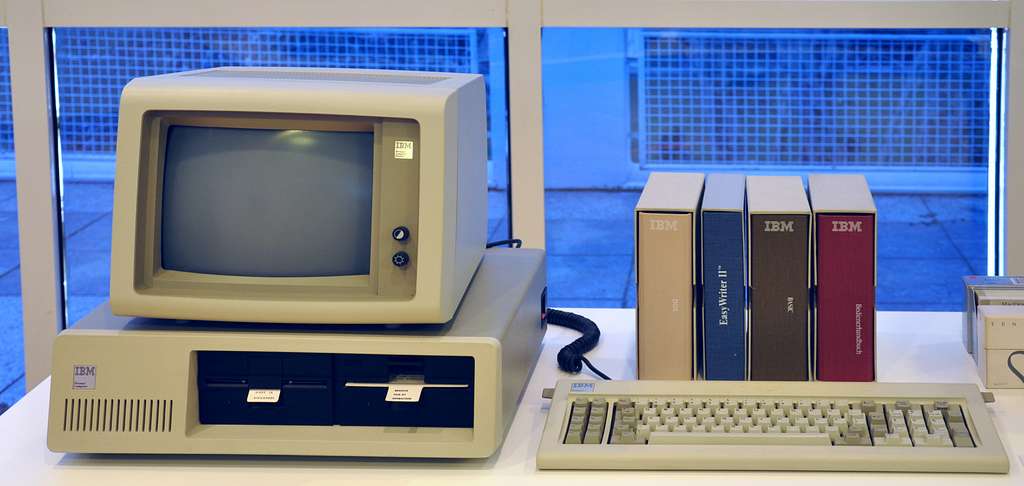
After the introduction of the IBM PC ways of programming changed dramatically. First, IBM, by creating an open-architecture system, had introduced a standard that all other PCs followed (except Apple, who were not looking for number-crunching uses). Second, the memory available expanded beyond 64k – the limit for 8bit computers. This meant that serious software businesses no longer needed or wanted proprietary systems, but could offer programs using standard technology that could sit alongside all the other potential uses of the machine. The age of the custom-built operating system was over.
During this period, though, programming developed by leaps and bounds. I was arrogant enough to believe that I was ahead of the game in software development, apart from the one time when I was given a demonstration of Visicalc, the first commercial spreadsheet program available for the Apple II, and the first spreadsheet program available for any PC. The astonishingly simple idea that you could write formulae into cells made me wish I had thought of it.
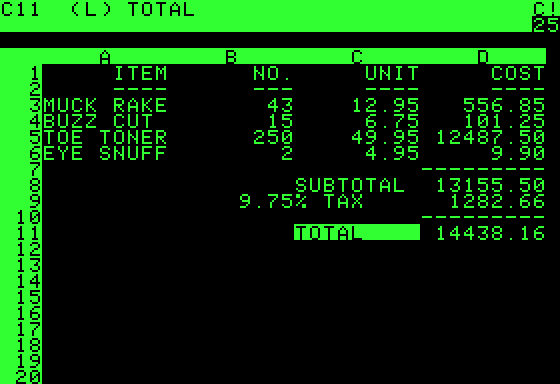
Jumping ahead, one of the key design requirements of Azquo was that it should interface seamlessly with spreadsheets. Some years later I was at a show called ‘Demo’ in Palm Springs, demonstrating an early version of Azquo, and was lucky enough to meet Dan Bricklin, who programmed Visicalc. I wanted to talk to him about the relationship between spreadsheets and databases, and how I had taken his work and extended the idea, but it was a fleeting concept, and I was left simply with the stock idea of him being a bearded technical nerd. The conference was packed with early PC innovators, so I missed a genuine opportunity to talk properly to one of the really significant names in computing.
Towards the end of the 80s, I was at a loose end – my main project having run its course, so was looking for a new project. This is where Rupert Armitage came into my life, and where the seeds of what became Azquo were planted. But that’s for next time